The night Pickett disappeared (September 8–9)
Turtles All the Way DownThe night Pickett disappeared (September 8–9) is the unresolved interval at the center of the search for Russell Pickett: a seemingly ordinary evening at home gives way to an early-morning police raid and a disappearance whose crucial clue is a partial image from a night-vision camera. The accounts establish a narrow timeline, but they do not explain how Russell left or where he went.
Announcement and Last Reported Sighting
Aza Holmes and Daisy Ramirez first hear about the disappearance while scanning radio stations for a song. The broadcast identifies Pickett Engineering as an Indianapolis-based construction firm employing more than ten thousand people worldwide, and reports a $100,000 reward for information about its CEO, Russell Pickett. He had disappeared the night before a police raid on his home connected to a fraud and bribery investigation; his last reported sighting was at his riverside compound on September 8. Daisy immediately recognizes that Aza knows Russell’s son, Davis Pickett, from two summers at Camp Spero, where they had both attended a camp for children whose parents had died.
The radio announcement frames the disappearance as both a family crisis and a public investigation. The reward makes Russell’s absence a matter of civic attention, while Aza’s childhood connection to Davis brings the search close to her own life. At this point, the broadcast supplies a last-seen date and location, not an explanation of what occurred after Russell was seen.
The Report and the Household Timeline
Aza reads the missing-person report on her phone during biology class, finishing its few pages over the course of the school day. It describes the missing man as fifty-three, gray-haired and blue-eyed, six feet tall and about 220 pounds. He had a tattoo reading Nolite te bastardes carborundorum on his left shoulder blade, three small abdominal scars from gallbladder surgery, and was last seen in a horizontally striped navy-and-white nightshirt and light-blue boxer shorts. Police discovered him missing at 5:35 A.M. while raiding the house in connection with the corruption investigation.
The report’s account of who was present is notably sparse. Its witness statements, Aza observes, come from people who had not witnessed the disappearance; the report says that only Davis and his younger brother, Noah Pickett, were there that night. The front-entrance camera recorded two groundskeepers leaving at 5:40 P.M. Malik the Zoologist left at 5:52, Lyle at 6:02, and Rosa at 6:04. Those departures support Lyle’s earlier claim that there was no nighttime staff, narrowing the known household presence to Russell and his sons.
Davis’s statement describes a routine evening rather than a visible crisis. Rosa left pizza; Davis and Noah ate while playing a video game, and Russell came downstairs briefly to eat with them before returning upstairs. Davis said his father did not seem anxious and that he usually saw him for only a few minutes, or not at all. After dinner, the boys put their dishes in the sink; Davis helped Noah with homework, read on the couch while Noah played, then went upstairs around ten. He did homework, looked through his telescope at Vega and Epsilon Lyrae, and went to bed around eleven, recalling nothing unusual about the day.
The Night-Vision Photograph
A later search of the grounds gives the timeline a visual clue. Aza and Daisy find a small, black night-vision camera mounted about four feet up a tree. It is not password protected, and Aza connects to it by phone, deleting the first two images, which show the girls, before scrolling through photographs of deer, coyotes, raccoons, and possums taken over the preceding week.
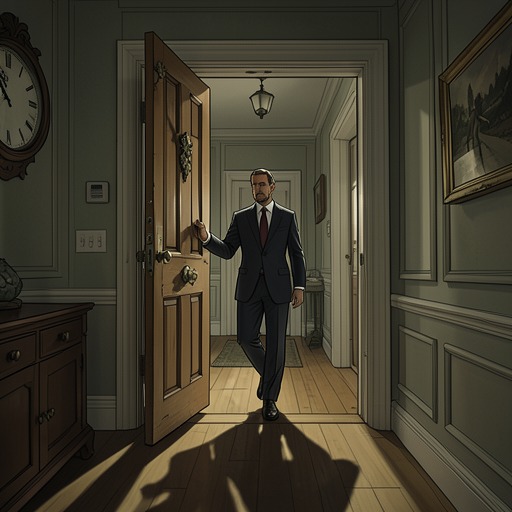
Among the images dated September 9, Aza finds a photograph timestamped 1:01:03 A.M. It shows the back of a stocky man wearing a striped nightshirt. The clothing and build echo details in the missing-person report, making the image relevant to Russell’s disappearance, but the view is only of the man’s back; it does not by itself establish his identity or reveal where he was going.
The moment of discovery is interrupted by a golf cart approaching in the girls’ direction. Daisy warns Aza that someone may have spotted them and runs off, while Aza stays to wait for the preceding photograph to load. It turns out to show a coyote. When Aza looks up and sees the man in the golf cart seeing her, she bolts. The camera has yielded a time-specific image, but the immediate danger cuts short their examination of it.
The Unresolved Interval
The night’s accounts leave a consequential gap between Davis’s recollection of going to bed around eleven and the photograph taken just after one in the morning. The staff departure times, the apparently ordinary family dinner, and Davis’s report of no unusual behavior establish what the investigation could document; none explains Russell’s disappearance. The striped nightshirt in the photograph links the camera image to the report’s description, while its limited angle preserves uncertainty. The interval therefore functions as both the mystery’s central chronology and a test of what partial records can establish: a last sighting, a household account, and an image, but no confirmed account of Russell’s departure.